
Why Chatbots Have Become the Backbone of Modern Lead Generation
Static contact forms are finished. When a prospect lands on your pricing page at 11pm on a Tuesday, they are not going to wait two business days for a response. They are going to bounce to a competitor who answers them right now. That is the core problem AI chatbots for lead generation solve — and the data backs it up decisively.
According to research from Salesforce, 68% of customers expect real-time engagement wherever they interact with a brand. Meanwhile, studies consistently show that responding to a lead within the first minute increases conversion chances by over 45%. Chatbots respond in seconds, every time, without lunch breaks or time zones. Shoppers who engage with AI chat convert at 12.3%, compared to just 3.1% for those who do not — a 4x lift in conversion rate that no SDR team can match at scale.
This guide cuts through the noise. We cover how chatbot lead generation actually works, what separates good platforms from great ones, a side-by-side comparison of the top tools, and how chatbots slot into a wider lead generation stack alongside tools like HubSpot Marketing Hub and OptinMonster.
How Chatbot Lead Generation Actually Works
A lead generation chatbot is not just a pop-up with a friendly face. Under the hood, several distinct mechanisms work together to turn anonymous visitors into qualified, CRM-ready prospects.
Proactive Engagement Triggers
Modern chatbots do not wait to be spoken to. They initiate conversations based on visitor behavior — a user who has spent three minutes on your pricing page is treated differently from someone who just arrived on the homepage. Triggers can include time on page, scroll depth, exit intent, or even the traffic source that brought the visitor in. This behavioral intelligence is what separates 2026-era AI chatbots from the rule-based bots of five years ago.
Automated Lead Qualification
Once a conversation starts, the chatbot runs a qualification sequence. Rather than a cold form asking for name and email, a well-designed bot asks questions naturally — "What's your company size?", "What's your biggest challenge right now?", "Are you evaluating vendors this quarter?" The answers are scored in real time, and high-intent leads are routed immediately to a human rep or booked directly into a calendar. Lower-intent leads enter a nurture sequence automatically.
This is where Natural Language Processing (NLP) earns its keep. Modern platforms understand context and intent even when prospects type informally, use abbreviations, or jump between topics mid-conversation. The best tools also detect sentiment, flagging frustrated visitors for priority human escalation.
CRM Sync and Data Enrichment
The final step — and the one most teams underestimate — is what happens after the conversation ends. A chatbot that captures a lead but drops the data somewhere outside your CRM is just creating more manual work. The best platforms push structured lead records directly into Salesforce, HubSpot, or your tool of choice, with conversation history, qualification score, and contact details already populated. Pair this with a data enrichment layer from a tool like Clearbit / HubSpot Breeze Intelligence and you can automatically append firmographic data — company size, industry, revenue — to every lead the chatbot captures.
The Top Chatbot Lead Generation Tools Compared
The market has matured significantly. There is no single "best" chatbot — the right choice depends on your team size, technical resources, and where chatbot fits within your broader funnel. Here is a direct comparison of the leading platforms based on tested performance, published pricing, and documented integration depth.
| Tool | Best For | Starting Price (Monthly) | AI Resolution Rate | Key Integrations | Automation Level |
|---|---|---|---|---|---|
| Drift | Enterprise B2B sales teams | $2,500 | High (rules-based + AI prediction) | Salesforce, HubSpot, Marketo | Semi-automated |
| Intercom | Hybrid support + lead gen | Tiered by features/users | Strong (hybrid human-AI) | CRM, marketing automation, custom APIs | Hybrid |
| Tidio | Small businesses and e-commerce | Free plan available | 67% | Shopify, WordPress | AI + rule-based |
| Landbot | No-code visual flow building | $30 | Configurable (user-defined flows) | Google Sheets, HubSpot, Zapier, WhatsApp | Rule-based |
| eesel AI | Knowledge-unified lead automation | $299 | High (minutes to deploy) | Zendesk, Google Docs, Confluence, Shopify | AI-driven |
| Botsonic | Simple website content Q&A | $19 | Moderate | Zapier, Webflow | AI + basic flows |
| 11x | Autonomous inbound + outbound GTM | Custom enterprise | High (self-learning, adaptive) | Salesforce, HubSpot, multi-channel | Fully autonomous agents |
Newsletter
Get the latest SaaS reviews in your inbox
By subscribing, you agree to receive email updates. Unsubscribe any time. Privacy policy.
Our Take on the Top Three
Drift at $2,500/month is a serious investment, and it is priced for enterprise B2B teams with a real sales motion behind it. The depth of its Salesforce and Marketo integrations is genuinely best-in-class, and if your average deal size justifies the spend, the semi-automated qualification workflows are among the most mature in the market. That said, smaller teams should look elsewhere — the onboarding requires a demo, and the ROI math only works at scale.
Tidio is the standout value play. A documented 67% AI resolution rate is impressive by any benchmark, the free plan lets you validate fit before committing, and the Shopify and WordPress integrations make it the obvious starting point for e-commerce and SMB use cases. It does not have the enterprise depth of Drift or 11x, but for most small-to-mid-market websites, it covers the core use cases cleanly.
11x occupies a different category entirely — less a chatbot and more a fully autonomous AI agent that handles both inbound qualification and outbound outreach within the same platform. For growth teams that want to eliminate the boundary between inbound lead capture and outbound prospecting, the self-learning conversation intelligence is the most technically advanced option in this comparison. The custom enterprise pricing reflects that.
Where Chatbots Fit in Your Wider Lead Generation Stack
A chatbot does not replace your lead generation infrastructure — it amplifies it. The highest-performing teams treat chatbots as one layer in a multi-tool stack, not a standalone silver bullet.
Top-of-Funnel: Traffic and Landing Pages
Chatbots convert traffic that is already on your site. To maximize their impact, you need that traffic to be qualified before it arrives. Landing page tools like Unbounce and Leadpages let you build high-converting, segment-specific pages that prime visitors before the chatbot ever fires. A prospect who clicked a targeted PPC ad and landed on a relevant page is far more likely to engage with a chatbot than someone who wandered in through organic search on a broad keyword.
Mid-Funnel: Identifying and Enriching Leads
Not every lead will engage with your chatbot — some visitors browse anonymously and leave. Tools like Leadfeeder identify which companies visited your site even when no form was submitted or chatbot conversation was had. Combine this with contact-level data from Apollo.io and you have a complete picture: chatbot conversations for engaged visitors, reverse IP identification for passive browsers, and enriched contact records for both.
Bottom-of-Funnel: CRM Handoff and Follow-Up
This is where most teams leak value. A chatbot that qualifies a lead is only as useful as the process that follows it up. The integration between your chatbot and your CRM needs to be airtight — structured data, not just a free-text conversation transcript. Leads captured at 2am need to be in the right rep's queue by 9am, with context intact. Platforms that write directly to HubSpot or Salesforce deal objects, rather than just contact records, are significantly more valuable for teams with a defined sales process.
What to Look for When Choosing a Chatbot Lead Generation Tool
With dozens of platforms competing for attention, the decision criteria matter more than the marketing claims on any individual vendor's homepage. Here is what actually separates tools that drive pipeline from tools that just look good in demos.
Qualification Logic and Routing Rules
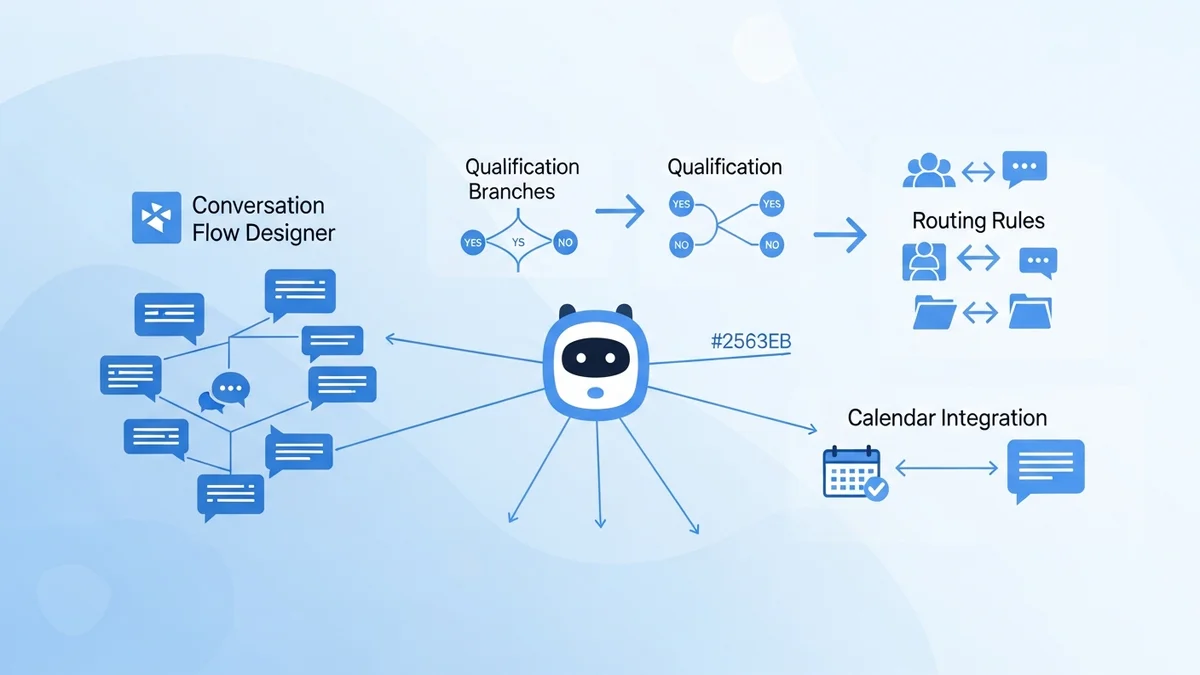
Can the chatbot route different lead types to different workflows? A demo request from a 500-person company should behave differently than a pricing question from a solo founder. The best platforms support conditional branching, lead scoring thresholds, and calendar integrations that allow high-intent leads to book meetings without human intervention. Platforms that only support linear flows will create bottlenecks at scale.
Integration Depth vs. Integration Breadth
A chatbot that claims 100+ integrations is not inherently better than one with 10 deep ones. What matters is whether the integrations are bidirectional and structured. Can the chatbot pull data from your CRM to personalize conversations? Does it write lead records with all qualification fields populated, or just dump an email address? For teams already invested in a specific CRM or marketing automation platform, verify that the chatbot's native integration supports two-way data sync before committing.
Setup Time and Ongoing Maintenance
Enterprise platforms like Drift require a formal onboarding process. That is appropriate if you have the resources. But for teams that need something live this week, tools like Tidio (simple setup), Botsonic ($19/month, minutes to deploy), and Landbot (visual no-code builder from $30/month) offer a meaningfully faster path to production. Fast setup also means faster testing — the ability to iterate on conversation flows based on real data is a competitive advantage in itself.
AI Capability vs. Rule-Based Reliability
This is the most important trade-off in 2026. Pure AI chatbots can handle complex, open-ended conversations and learn from each interaction — but they can also hallucinate, go off-script, or give inconsistent answers in high-stakes sales contexts. Rule-based bots are predictable but rigid. The best lead generation chatbots layer both: AI for understanding intent and handling unexpected inputs, rule-based flows for high-value qualification sequences where consistency matters. Evaluate platforms on how they handle this hybrid architecture, not just whether they claim to use AI.
The Business Case: What Chatbot Lead Generation Delivers
The market trajectory makes the investment case clear. The AI chatbot market is projected to reach $27.29 billion by 2030, growing at 23.3% annually — not because vendors are spending on marketing, but because the ROI at the company level is measurable. Businesses deploying AI chatbots for lead generation report more than a 30% increase in lead conversion rates. 64% of businesses report that AI chatbots help them generate more qualified leads. The 4x conversion rate lift from chat engagement versus no engagement is consistent across multiple independent datasets.
The compounding benefit is cost per lead. Once a chatbot is configured and integrated, it handles an unlimited volume of simultaneous conversations at no marginal cost. A human SDR making qualification calls can run three or four conversations per hour. An AI chatbot can run thousands. For high-traffic websites where the economics of manual qualification break down above a certain lead volume, the automation multiplier is genuinely transformative.
The teams seeing the best results treat their chatbot as a living system, not a one-time setup. They review conversation drop-off points weekly, test new qualification questions monthly, and update routing logic whenever their ICP or product positioning shifts. The data those conversations generate — what prospects ask, what objections come up, what language they use to describe their problems — is valuable beyond the leads themselves. It informs product messaging, sales enablement, and content strategy across the entire go-to-market function.
If you have not deployed a lead generation chatbot yet, the barrier to entry has never been lower. A tool like Botsonic gets you live for $19/month. Tidio and Landbot both offer free plans to test the fundamentals. Start with a single high-traffic page, a simple qualification sequence, and a direct integration to wherever your leads currently live. Measure the conversion rate difference against your existing form. The data will make the case for you.