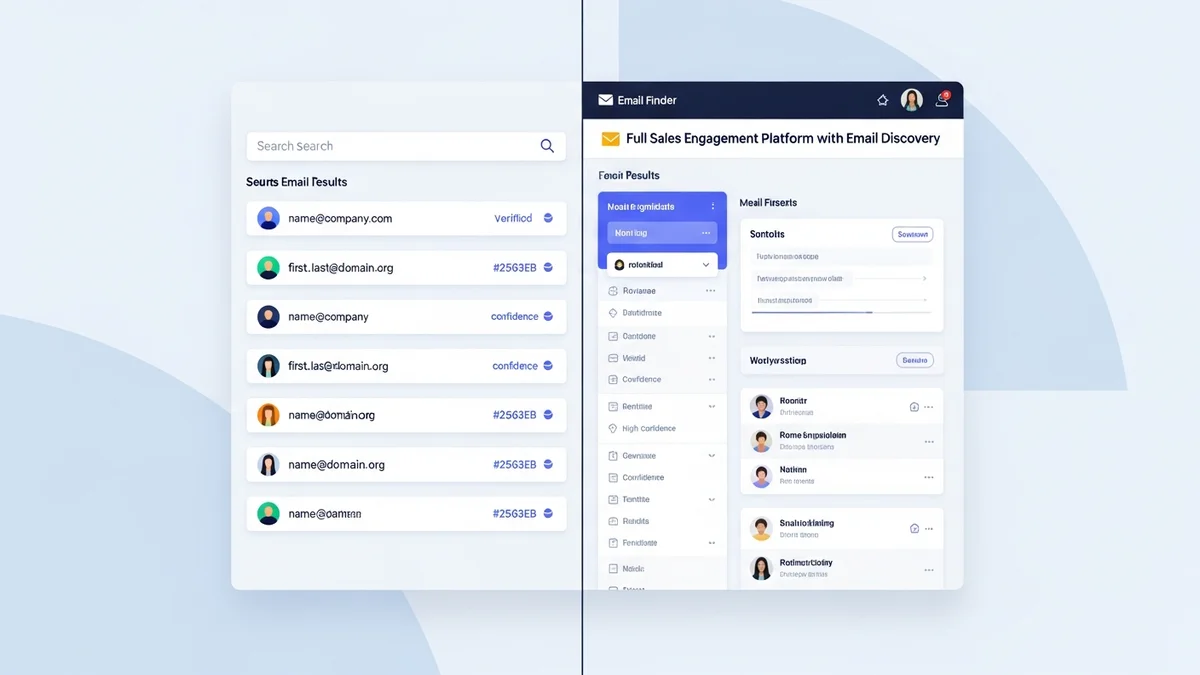

Hunter vs Apollo: Which Email Finder Actually Delivers in 2026?
Both Hunter.io and Apollo.io have carved out loyal followings in the B2B prospecting world — but they solve fundamentally different problems. Hunter was built around a single elegant idea: type in a domain, get email addresses. Apollo took the opposite approach, building a sprawling sales intelligence platform where email finding is just one piece of a much larger machine.
If you land on the wrong tool, you either overpay for features you'll never use, or you find yourself stitching together workarounds because your tool can't keep up with your workflow. This comparison breaks down exactly where each one wins, where each one falls short, and which scenarios make the choice obvious.
What Each Tool Actually Does
Hunter.io: The Focused Email Finder
Hunter's core product is its Domain Search. Enter any company website and you get a list of publicly discoverable email addresses associated with that domain, along with the sources where Hunter found them. That transparency — showing you exactly where each email was sourced — is genuinely useful for compliance-conscious teams and sets Hunter apart from tools that just hand you a CSV with no provenance.
The tool also includes an Email Verifier, a bulk task feature for processing large lists, and a browser extension that works across LinkedIn and company websites. Hunter's interface is clean to the point of being sparse. That's not a criticism — it's intentional design. You can get up and running in minutes without reading a single documentation page.
Where Hunter shows its age is in enrichment depth. You get the email address and sometimes a name and role. You don't get buying signals, technographic data, job change alerts, or intent data. For teams that need those layers, Hunter is the starting point of a workflow, not the whole workflow.
Apollo.io: The Full Sales Intelligence Platform
Apollo.io is playing a different game entirely. Its database contains hundreds of millions of contacts and companies. Beyond email finding, Apollo includes sequence automation, CRM sync, call recording, lead scoring, intent data, and territory management. Email lookup is almost a footnote in what Apollo can do.
That breadth is both Apollo's biggest selling point and its primary weakness. Teams that need a full outbound stack get enormous value from Apollo's ecosystem. Teams that just want verified email addresses often find themselves navigating features they'll never touch, and the accuracy of Apollo's contact data — while impressive at scale — can be less precise for niche industries or smaller markets compared to Hunter's more curated approach.
Head-to-Head Feature Comparison
| Feature | Hunter.io | Apollo.io |
|---|---|---|
| Primary use case | Domain-based email lookup | Full-stack sales intelligence |
| Email accuracy | 95%+ (with source transparency) | 8.5/10 with real-time verification |
| Database size | Domain-sourced, curated | Hundreds of millions of contacts |
| Email sequences / outreach | Basic campaigns | Full multi-step sequences |
| CRM integrations | HubSpot, Salesforce, Pipedrive | HubSpot, Salesforce, and 200+ others |
| Browser extension | Yes (LinkedIn + websites) | Yes (LinkedIn + websites) |
| Intent data | No | Yes |
| Lead scoring | No | Yes |
| Bulk email verification | Yes | Yes |
| Free plan | Yes | Yes |
| SoftwareSuggest rating | 4.7/5 | 4.5/5 |
Newsletter
Get the latest SaaS reviews in your inbox
By subscribing, you agree to receive email updates. Unsubscribe any time. Privacy policy.
Pricing: What You Pay and What You Get
Apollo's pricing structure is more transparent than many enterprise-leaning competitors. The free tier is genuinely useful for small teams testing the platform, and paid plans scale from $49/month for Basic to $99/month for Professional. The Professional tier unlocks advanced sequences, AI-assisted writing, and deeper analytics — features that start to matter once you're running structured outbound campaigns at volume.
Hunter's free plan gives you 25 searches per month, which is enough to validate the product but not enough to run any serious prospecting effort. Their paid tiers scale based on the number of searches, making the cost model straightforward and predictable. Hunter's strength here is that you're paying only for what you actually use: email lookup, not an entire sales stack you may not need.
The honest pricing comparison: Apollo costs more at scale because it does more. If you're already paying for a separate sequencing tool, a separate intent data provider, and a separate CRM enrichment service, Apollo's bundled approach can actually reduce your total tooling spend. If email lookup is all you need, Hunter's focused pricing model wins.
| Plan | Apollo.io | Hunter.io |
|---|---|---|
| Free | Yes — limited credits | Yes — 25 searches/month |
| Entry paid tier | $49/month (Basic) | Starter tier available |
| Mid-tier | $99/month (Professional) | Growth tier available |
| Enterprise | Organization plan (custom) | Business plan (custom) |
Who Should Choose Hunter
Hunter is the right choice when simplicity and data transparency are your primary requirements. If you're a PR professional building media lists, a recruiter doing targeted outreach, or a small sales team that just needs to find the right contact at a company without navigating a complex platform, Hunter delivers what you need with almost zero friction.
Hunter's source-showing feature matters more than it might seem. Knowing that an email was found in a public newsletter footer versus scraped from a website contact form is genuinely useful for prioritizing your outreach and staying on the right side of data privacy expectations. No other tool in this category makes that information as accessible.
The tool also integrates cleanly with HubSpot Marketing Hub, letting smaller teams enrich their CRM contact records without a complex data pipeline. For teams already running inbound campaigns through HubSpot, Hunter can slot in as a clean complement for outbound prospecting.
Who Should Choose Apollo
Apollo is built for sales teams that want to consolidate their outbound stack. If you're currently juggling a prospecting tool, a sequencing platform, and a data enrichment service, Apollo can replace all three. The efficiency gain isn't just cost-related — having prospecting, outreach, and tracking in one place means your reps spend less time switching between tools and more time actually selling.
Apollo's database depth also makes it the better choice for high-volume prospecting. When you're building lists of thousands of contacts based on firmographic filters — industry, company size, job title, technology stack — Apollo's search capabilities far outpace Hunter's domain-focused approach. Hunter finds emails for companies you've already identified. Apollo helps you identify which companies to target in the first place.
Teams building out a larger lead generation stack should also consider how Apollo fits alongside tools like ZoomInfo and Cognism. ZoomInfo wins for enterprise-grade data depth in North America; Cognism leads for GDPR-compliant European prospecting; Apollo sits in the middle as a strong generalist with the best price-to-feature ratio for mid-market teams.
A Note on Database Accuracy
At scale, Apollo's accuracy is rated at 8.5/10 — strong, but not perfect. Hunter posts 95%+ accuracy claims, which is plausible given its more curated, domain-sourced approach. The practical implication: Hunter's smaller, more focused dataset tends to produce cleaner results per search, while Apollo's broader database trades some per-record precision for dramatically more coverage. Neither tool eliminates bounce risk entirely, which is why running emails through a dedicated verifier before sending to a cold list remains good practice regardless of which platform you use.
Integration Ecosystem and Workflow Fit
Both tools connect to major CRMs, but Apollo's integration depth is considerably broader. Apollo's native sequences, A/B testing, and analytics mean you can manage a complete outbound campaign without leaving the platform. Hunter's campaign feature exists, but it's lightweight — clearly an add-on rather than a core product.
For teams using landing page tools like Leadpages or Instapage for inbound capture, the outbound side of the equation needs a tool that can handle list enrichment cleanly. Hunter's straightforward API makes it easy to enrich contact records in lightweight setups. Apollo's broader API covers more enrichment dimensions but requires more implementation work to configure correctly.
The Verdict: Focused vs. Full-Stack
The Hunter vs. Apollo comparison isn't really about which tool is better — it's about which problem you're actually trying to solve.
Choose Hunter if: You need clean, transparent email lookup with minimal setup. Your team is small, your workflow is simple, and you value accuracy and source transparency over volume. You want a tool that does one thing exceptionally well without paying for features you'll ignore.
Choose Apollo if: You want a consolidated outbound stack. You need to identify target accounts, not just find contacts at companies you've already researched. You're running multi-step sequences and want prospecting, outreach, and tracking in one place. The $49–$99/month price point represents a consolidation saving compared to stitching together multiple tools.
For most growing B2B sales teams, Apollo wins on pure functional breadth. For researchers, PR professionals, and lean outbound operations where data quality beats data volume, Hunter remains the most reliable tool in the category. Both tools offer free tiers — test them both on your actual use case before committing to either.